TinEye is a reverse image search engine developed and offered by Idée, Inc., a company based in Toronto, Ontario, Canada. It was the first image search engine on the web to use image identification technology rather than keywords, metadata or watermarks. TinEye allows users to search not using keywords but with images. Upon submitting an image, TinEye creates a "unique and compact digital signature or fingerprint" of the image and matches it with other indexed images. This procedure is able to match even heavily edited versions of the submitted image, but will not usually return similar images in the results. == History == Idée, Inc. was founded by Leila Boujnane and Paul Bloore in 1999. Idée launched the service on May 6, 2008 and went into open beta in August that year. While computer vision and image identification research projects began as early as the 1980s, the company claims that TinEye is the first web-based image search engine to use image identification technology. The service was created with copyright owners and brand marketers as the intended user base, to look up unauthorized use and track where the brands are showing up respectively. In June 2014, TinEye claimed to have indexed more than five billion images for comparisons. However, this is a relatively small proportion of the total number of images available on the World Wide Web. As of September 2025, TinEye's search results claim to have over 77.6 billion images indexed for comparison. == Technology == A user uploads an image to the search engine (the upload size is limited to 20 MB) or provides a URL for an image or for a page containing the image. The search engine will look up other usage of the image in the internet, including modified images based upon that image, and report the date and time at which they were posted. TinEye does not recognize outlines of objects or perform facial recognition, but recognizes the entire image, and some altered versions of that image. This includes smaller, larger, and cropped versions of the image. TinEye has shown itself capable of retrieving different images from its database of the same subject, such as famous landmarks. TinEye is capable of searching for images in JPEG, PNG, WebP, GIF, BMP and TIFF format. Results generated from TinEye include the total number of matches in their database, a preview image, and the URL to each match. TinEye can sort results by best match, most changed, biggest image, newest, and oldest. User registration is optional and offers storage of the user's previous queries. Other features include embeddable widgets and bookmarklets. TinEye has also released their commercial API. == Usage == TinEye's ability to search the web for specific images (and modifications of those images) makes it a potential tool for the copyright holders of visual works to locate infringements on their copyright. It also creates a possible avenue for people who are looking to make use of imagery under orphan works to find the copyright holders of that imagery. Being that orphan works can be defined as "copyrighted works whose owners are difficult or impossible to identify and/or locate," the use of TinEye could potentially remove the orphan work status from online images that can be found in its database. === Fact-checking === It has been recommended by fact-checkers as a useful resource in attempts to verify the origin of images. As of 2019, TinEye specialized in copyright violations and finding exact versions of images online.
Robot learning
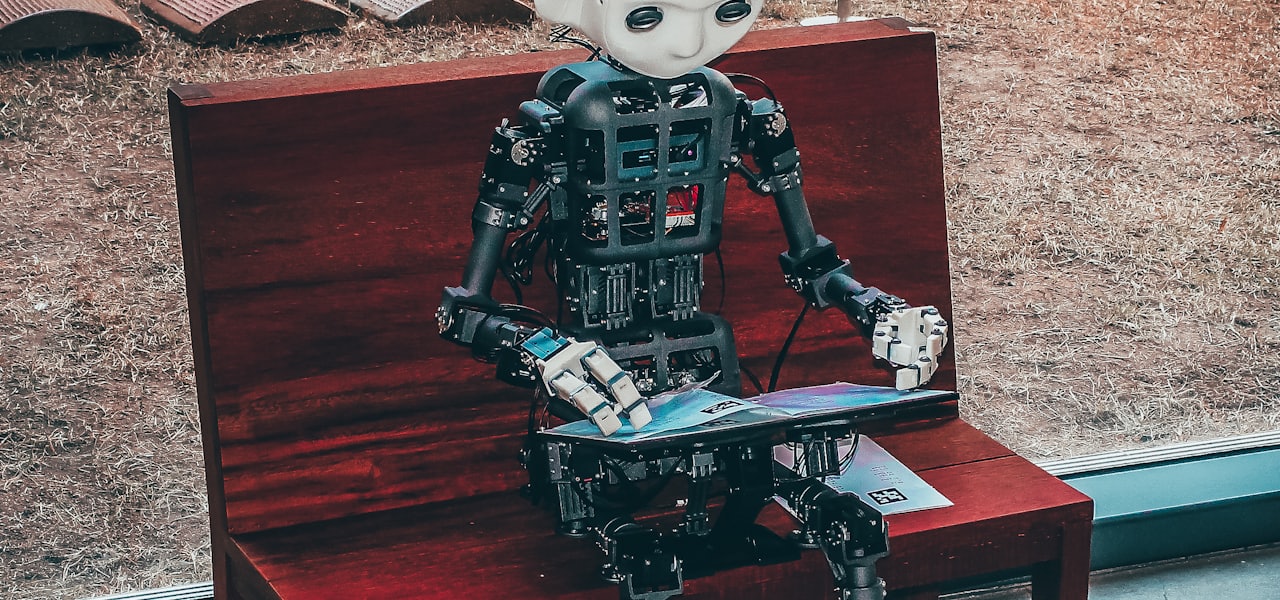
Robot learning is a research field at the intersection of machine learning and robotics. It studies techniques allowing a robot to acquire novel skills or adapt to its environment through learning algorithms. The embodiment of the robot, situated in a physical embedding, provides at the same time specific difficulties (e.g. high-dimensionality, real time constraints for collecting data and learning) and opportunities for guiding the learning process (e.g. sensorimotor synergies, motor primitives). Example of skills that are targeted by learning algorithms include sensorimotor skills such as locomotion, grasping, active object categorization, as well as interactive skills such as joint manipulation of an object with a human peer, and linguistic skills such as the grounded and situated meaning of human language. Learning can happen either through autonomous self-exploration or through guidance from a human teacher, like for example in robot learning by imitation. Robot learning can be closely related to adaptive control, reinforcement learning as well as developmental robotics which considers the problem of autonomous lifelong acquisition of repertoires of skills. While machine learning is frequently used by computer vision algorithms employed in the context of robotics, these applications are usually not referred to as "robot learning". == Imitation learning == Many research groups are developing techniques where robots learn by imitating. This includes various techniques for learning from demonstration (sometimes also referred to as "programming by demonstration") and observational learning. == Sharing learned skills and knowledge == In Tellex's "Million Object Challenge", the goal is robots that learn how to spot and handle simple items and upload their data to the cloud to allow other robots to analyze and use the information. RoboBrain is a knowledge engine for robots which can be freely accessed by any device wishing to carry out a task. The database gathers new information about tasks as robots perform them, by searching the Internet, interpreting natural language text, images, and videos, object recognition as well as interaction. The project is led by Ashutosh Saxena at Stanford University. RoboEarth is a project that has been described as a "World Wide Web for robots" − it is a network and database repository where robots can share information and learn from each other and a cloud for outsourcing heavy computation tasks. The project brings together researchers from five major universities in Germany, the Netherlands and Spain and is backed by the European Union. Google Research, DeepMind, and Google X have decided to allow their robots share their experiences. == Vision-language-action model == Research groups and companies are developing vision-language-action models, foundation models that allow robotic control through the combination of vision and language. Google DeepMind, Figure AI and Hugging Face are actively working on that.
Screen space directional occlusion
Screen space directional occlusion (SSDO) is a computer graphics technique enhancing screen space ambient occlusion (SSAO) by taking direction into account to sample the ambient light (both the light coming directly at an object, as well as the light reflected off of the object directly behind it), to better approximate global illumination. SSDO was introduced by Tobias Ritschel, Thorsten Grosch, and Hans-Peter Seidel in their 2009 ACM Symposium on Interactive 3D Graphics and Games paper Approximating dynamic global illumination in image space, which describes it as extending SSAO to directional occlusion with one diffuse indirect bounce of light; later literature notes that SSDO still suffers from common screen-space artifacts such as noise and banding. == Method == The original SSDO paper describes a two-pass screen-space approach, with one pass for direct lighting and a second pass for indirect bounces. Later literature describes SSDO as assuming a general shadowing direction that allows color bleeding and a single light bounce.
Puck App
Puck App is a mobile application that allows hockey players to quickly find and rent a hockey goalie. Founded in 2015 in Toronto, the application primarily operates throughout Canada. It is available on Apple's App Store and Google Play. == History == Puck App was founded in 2016 by Niki Sawni. Users can rate the goalies, message with available goalies, and coordinate skill levels. In 2017, Puck App expanded to Western Canada and has over 1,000 goalies registered. In 2018, Puck App charged approximately $40 CDN to rent a goalie with more than 2 hours notice. Previously, Puck App was a competitor to a similar application called GoalieUp. As of 2024, both companies have agreed to a merger deal.
Nobody (username)
In many Unix variants, "nobody" is the conventional name of a user identifier which owns no files, is in no privileged groups, and has no abilities except those which every other user has. It is normally not enabled as a user account, i.e. has no home directory or login credentials assigned. Some systems also define an equivalent group "nogroup". == Uses == The pseudo-user "nobody" and group "nogroup" are used, for example, in the NFSv4 implementation of Linux by idmapd, if a user or group name in an incoming packet does not match any known username on the system. It was once common to run daemons as nobody, especially on servers, in order to limit the damage that could be done by a malicious user who gained control of them. However, the usefulness of this technique is reduced if more than one daemon is run like this, because then gaining control of one daemon would provide control of them all. The reason is that processes owned by the same user have the ability to send signals to each other and use debugging facilities to read or even modify each other's memory. Modern practice, as recommended by the Linux Standard Base, is to create a separate user account for each daemon.
Adversarial machine learning
Adversarial machine learning is the study of the attacks on machine learning algorithms, and of the defenses against such attacks. Machine learning techniques are mostly designed to work on specific problem sets, under the assumption that the training and test data are generated from the same statistical distribution (IID). However, this assumption is often violated in practical high-stake applications, where users may intentionally supply fabricated data that violates the statistical assumption. Most common attacks in adversarial machine learning include evasion attacks, data poisoning attacks, Byzantine attacks and model extraction. == History == At the MIT Spam Conference in January 2004, John Graham-Cumming showed that a machine-learning spam filter could be used to defeat another machine-learning spam filter by automatically learning which words to add to a spam email to get the email classified as not spam. In 2004, Nilesh Dalvi and others noted that linear classifiers used in spam filters could be defeated by simple "evasion attacks" as spammers inserted "good words" into their spam emails. (Around 2007, some spammers added random noise to fuzz words within "image spam" in order to defeat OCR-based filters.) In 2006, Marco Barreno and others published "Can Machine Learning Be Secure?", outlining a broad taxonomy of attacks. As late as 2013 many researchers continued to hope that non-linear classifiers (such as support vector machines and neural networks) might be robust to adversaries, until Battista Biggio and others demonstrated the first gradient-based attacks on such machine-learning models (2012–2013). In 2012, deep neural networks began to dominate computer vision problems; starting in 2014, Christian Szegedy and others demonstrated that deep neural networks could be fooled by adversaries, again using a gradient-based attack to craft adversarial perturbations. Further work would show that adversarial attacks are harder to produce in uncontrolled environments, due to the different environmental constraints that cancel out the effect of noise. For example, any small rotation or slight illumination on an adversarial image can destroy the adversariality. In addition, researchers such as Google Brain's Nick Frosst point out that it is much easier to make self-driving cars miss stop signs by physically removing the sign itself, rather than creating adversarial examples. Frosst also believes that the adversarial machine learning community incorrectly assumes models trained on a certain data distribution will also perform well on a completely different data distribution. He suggests that a new approach to machine learning should be explored, and is currently working on a unique neural network that has characteristics more similar to human perception than state-of-the-art approaches. While adversarial machine learning continues to be heavily rooted in academia, large tech companies such as Google, Microsoft, and IBM have begun curating documentation and open source code bases to allow others to concretely assess the robustness of machine learning models and minimize the risk of adversarial attacks. === Examples === Examples include attacks in spam filtering, where spam messages are obfuscated through the misspelling of "bad" words or the insertion of "good" words; attacks in computer security, such as obfuscating malware code within network packets or modifying the characteristics of a network flow to mislead intrusion detection; attacks in biometric recognition where fake biometric traits may be exploited to impersonate a legitimate user; or to compromise users' template galleries that adapt to updated traits over time. Researchers showed that by changing only one-pixel it was possible to fool deep learning algorithms. Others 3-D printed a toy turtle with a texture engineered to make Google's object detection AI classify it as a rifle regardless of the angle from which the turtle was viewed. Creating the turtle required only low-cost commercially available 3-D printing technology. A machine-tweaked image of a dog was shown to look like a cat to both computers and humans. A 2019 study reported that humans can guess how machines will classify adversarial images. Researchers discovered methods for perturbing the appearance of a stop sign such that an autonomous vehicle classified it as a merge or speed limit sign. A data poisoning filter called Nightshade was released in 2023 by researchers at the University of Chicago. It was created for use by visual artists to put on their artwork to corrupt the data set of text-to-image models, which usually scrape their data from the internet without the consent of the image creator. McAfee attacked Tesla's former Mobileye system, fooling it into driving 50 mph over the speed limit, simply by adding a two-inch strip of black tape to a speed limit sign. Adversarial patterns on glasses or clothing designed to deceive facial-recognition systems or license-plate readers, have led to a niche industry of "stealth streetwear". An adversarial attack on a neural network can allow an attacker to inject algorithms into the target system. Researchers can also create adversarial audio inputs to disguise commands to intelligent assistants in benign-seeming audio; a parallel literature explores human perception of such stimuli. Clustering algorithms are used in security applications. Malware and computer virus analysis aims to identify malware families, and to generate specific detection signatures. In the context of malware detection, researchers have proposed methods for adversarial malware generation that automatically craft binaries to evade learning-based detectors while preserving malicious functionality. Optimization-based attacks such as GAMMA use genetic algorithms to inject benign content (for example, padding or new PE sections) into Windows executables, framing evasion as a constrained optimization problem that balances misclassification success with the size of the injected payload and showing transferability to commercial antivirus products. Complementary work uses generative adversarial networks (GANs) to learn feature-space perturbations that cause malware to be classified as benign; Mal-LSGAN, for instance, replaces the standard GAN loss with a least-squares objective and modified activation functions to improve training stability and produce adversarial malware examples that substantially reduce true positive rates across multiple detectors. == Challenges in applying machine learning to security == Researchers have observed that the constraints under which machine-learning techniques function in the security domain are different from those of common benchmark domains. Security data may change over time, include mislabeled samples, or reflect adversarial behavior, which complicates evaluation and reproducibility. === Data collection issues === Security datasets vary across formats, including binaries, network traces, and log files. Studies have reported that the process of converting these sources into features can introduce bias or inconsistencies. In addition, time-based leakage can occur when related malware samples are not properly separated across training and testing splits, which may lead to overly optimistic results. === Labeling and ground truth challenges === Malware labels are often unstable because different antivirus engines may classify the same sample in conflicting ways. Ceschin et al. note that families may be renamed or reorganized over time, causing further discrepancies in ground truth and reducing the reliability of benchmarks. === Concept drift === Because malware creators continuously adapt their techniques, the statistical properties of malicious samples also change. This form of concept drift has been widely documented and may reduce model performance unless systems are updated regularly or incorporate mechanisms for incremental learning. === Feature robustness === Researchers differentiate between features that can be easily manipulated and those that are more resistant to modification. For example, simple static attributes, such as header fields, may be altered by attackers, while structural features, such as control-flow graphs, are generally more stable but computationally expensive to extract. === Class imbalance === In realistic deployment environments, the proportion of malicious samples can be extremely low, ranging from 0.01% to 2% of total data. This unbalanced distribution causes models to develop a bias towards the majority class, achieving high accuracy but failing to identify malicious samples. Prior approaches to this problem have included both data-level solutions and sequence-specific models. Methods like n-gram and Long Short-Term Memory (LSTM) networks can model sequential data, but their performance has been shown to decline significantly when malware samples are realistically proportioned in the training set, demonstrating the limitations in
Computer Law & Security Review
The Computer Law & Security Review is an international peer-reviewed journal published by Elsevier. It has been published six times a year since 1985 and is indexed in Scopus and SSCI. It is accessible to a wide range of professional legal and IT practitioners, businesses, academics, researchers, libraries and organisations in both the public and private sectors. The journal regularly covers: CLSR Briefing with special emphasis on UK/US developments European Union update National news from 10 European jurisdictions Pacific rim news column Refereed practitioner and academic papers on topics such as Web 2.0, IT security, Identity management, ID cards, RFID, interference with privacy, Internet law, telecoms regulation, online broadcasting, intellectual property, software law, e-commerce, outsourcing, data protection and freedom of information and many other topics. The Journal's Correspondent Panel includes more than 40 specialists in IT law and security. Each issue contains articles, case law analysis and current news on information and communications technology. Special Features High quality peer reviewed papers from internationally renowned practitioner and academic experts Latest developments reported in situ by more than 20 leading law firms from around the world Highly experienced and respected editor and correspondents panel Online access to all 23 volumes of CLSR with embedded web links to primary sources Contact details of all authors A pool of expertise that can collectively identify the key topics that need to be examined.